%402x.svg)
Our first trip to Hawaii was actually a complete surprise. In 2015, Jason’s parents, Jack and Janet, sat the whole family down and told us they had a surprise for us. That surprise was that they were taking the entire family to Kauaʻi for 10 days! The four of us, Jason's parents, and his two brothers with their families. All 12 of us were going to Hawaii together.
Looking back 11 years later, I think that was an even bigger gift than we realized at the time. The kids were little, Maggie and Zac were babies, and we had 10 whole days with three generations of our family together in one of the most beautiful places in the world. Hawaii has a word most of us have heard even if we have never been there, ʻohana, which means family. You hear it used a lot in connection with Hawaii, but being there with our entire family made that word feel a little more meaningful to us. We were incredibly blessed to have that time together.
We went in October, and the weather was pretty much perfect. I remember temperatures in the 80s, plenty of sunshine and everything being unbelievably green. But one of the interesting things about Kauaʻi is that the weather can be completely different depending on which side of the island you are on. Kauaʻi sits in the path of the northeast trade winds, and as that moist air reaches the mountains it is pushed upward, cools and produces rain. That is a big reason the North Shore and mountainous interior are so incredibly lush and green, while the South Shore is generally sunnier and drier. The coastal West Side is even hotter and drier in places, and then you can drive up into Kōkeʻe and suddenly find yourself in cooler air with clouds or fog rolling through the mountains.
You can actually see those differences in the landscape as you travel around the island. The North Shore has incredibly green mountains, tropical vegetation and taro fields that almost look like they belong in another world. Head west and the vegetation becomes noticeably drier, particularly as you get closer to Waimea and Kekaha, before changing again as you climb into the higher elevations. Kauaʻi has all of these little microclimates packed into one relatively small island, so rain on one side absolutely does not mean your entire day is going to be rainy everywhere. Kauaʻi was our first Hawaiian island, and I think it spoiled us a little bit.
Kauaʻi is known as the Garden Island, and you understand why almost immediately. It is the oldest and northernmost of the main Hawaiian Islands. Millions of years of volcanic activity followed by wind, rain and erosion have carved the island into enormous green valleys, sharp mountain ridges, waterfalls, canyons and sea cliffs. All of that rain and erosion are also responsible for much of the lush landscape and dramatic scenery that earned Kauaʻi its nickname.
Kauaʻi also feels very different from some of the more developed parts of Hawaii. There is no Honolulu here. Much of the island still feels wild, and there are places you simply cannot reach by road. In fact, you cannot drive completely around Kauaʻi because the mountains and cliffs of the Nāpali Coast prevent a road from connecting the north and west sides of the island. Some of Kauaʻi’s most spectacular places are only accessible by hiking, boat or air.
One thing that makes Kauaʻi fairly easy to understand once you start exploring is that the island naturally divides into regions. You have the South Shore around Poʻipū, the West Side toward Waimea, the East Side around Wailua and Kapaʻa, and the North Shore around Kīlauea, Princeville and Hanalei. Each one feels a little different and has its own beaches, parks, towns and things to see. It also makes planning your days a lot easier because activities tend to group together naturally. Instead of driving back and forth across the island all week, you can spend a day exploring one region and see what is around you while you are there. That is actually how I plan Kauaʻi now too.
We made Poʻipū on the South Shore our home base. We rented a vacation home that was only about a five-minute walk from Poʻipū Beach, and we loved having a house for all of us. One thing we learned pretty quickly is that air conditioning isn’t necessarily a given in vacation homes on Kauaʻi. Ours didn’t have it. We had fans, kept the windows open at night and made do just fine. However, after not having AC, we make sure that is included moving forward! We also had a great deck off the front of the house where we could sit outside with a hot cup of coffee and start our mornings slowly.
And I cannot talk about waking up in Kauaʻi without talking about the chickens. There are chickens EVERYWHERE. Chickens in parking lots, chickens on beaches, chickens along the side of the road, chickens hanging around restaurants and roosters crowing whenever they darn well feel like it. I love chickens and roosters, so this was one of my favorite things about Kauaʻi. I loved waking up and hearing the roosters crowing, although “waking up” is a little misleading because they pretty much crow all day. 😂
The story behind Kauaʻi’s chickens is pretty interesting too. Polynesian voyagers brought chickens to the Hawaiian Islands centuries ago, and later settlers brought other domestic breeds. Hurricanes, particularly Iwa in 1982 and Iniki in 1992, damaged chicken coops and released domestic birds, which mixed with chickens already living wild on the island. The result is the huge population of free-roaming chickens you see all over Kauaʻi today. They are just part of Kauaʻi, and I loved every single one of them.
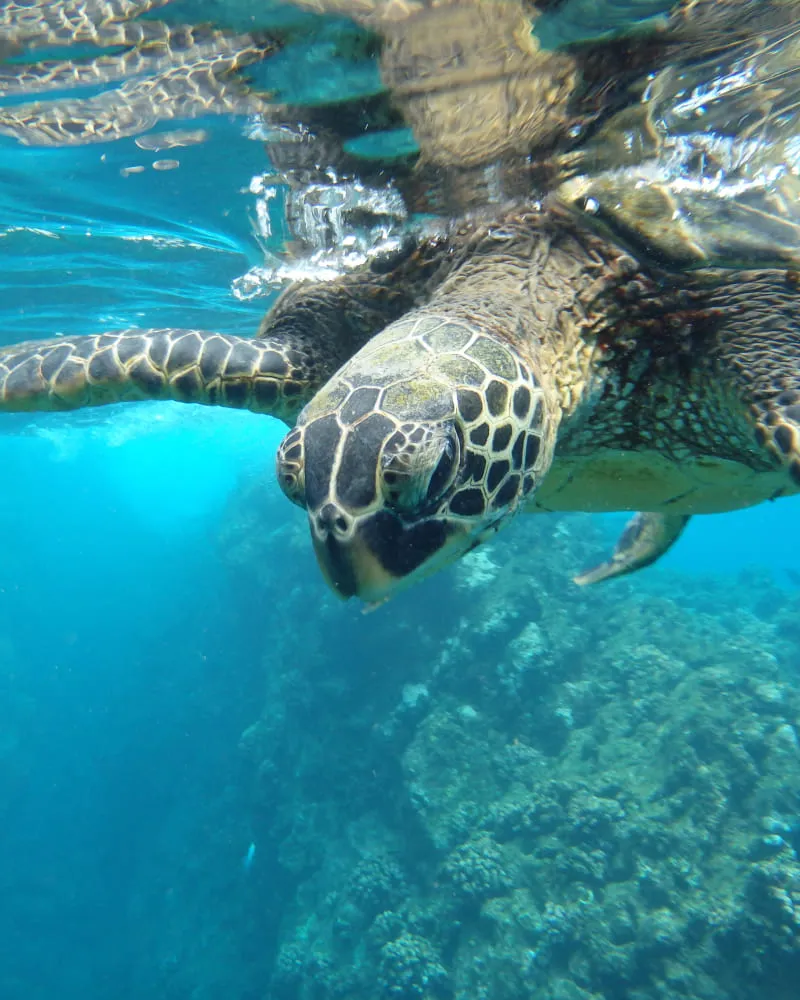
Jason and I are early risers (the time change basically forced us into that), so a lot of mornings we were awake before the sun and would take a quiet walk down to Poʻipū Beach before the crowds came out. Those mornings ended up being one of my favorite parts of the entire trip. Each morning, we would discover Hawaiian green sea turtles, called honu in Hawaiian, resting on the beach. We saw them while snorkeling too, and there is something pretty incredible about being in the water and watching one of these huge turtles peacefully swim by.
Green sea turtles are the largest hard-shelled sea turtles in the world. Despite the name, their shells aren’t actually green. The name comes from the greenish color of the fat inside their bodies. Hawaiian green sea turtles are also known for coming ashore to bask and rest, something that makes seeing them stretched out on a Hawaiian beach especially memorable. The honu also have cultural importance in Hawaii and appear throughout Hawaiian traditions, stories and artwork. For some Native Hawaiian families, honu may be regarded as an ʻaumākua, an ancestral family guardian. They are protected animals, so if you are lucky enough to find one resting on the beach, admire it from a respectful distance. We saw them over and over during our 10 days on Kauaʻi, and I never got tired of it.
Most mornings, we also got to see one of Hawaii’s rarest animals, the Hawaiian monk seal, or ʻīlio holo i ka uaua. Hawaiian monk seals are native to the Hawaiian Archipelago and are found nowhere else on Earth. They spend a huge amount of energy foraging at sea and then come ashore to rest, so finding one asleep on the beach does not mean it is stranded or needs help. We had several curious monk seals around the little bay while we were there, and sometimes they would swim surprisingly close to us. It was SO cool. When they haul out onto beaches, you may see areas marked off around them so they can rest without people crowding them. Seeing animals like the honu and monk seals over and over was one of the things that made Kauaʻi feel so special to us, and it also gave us a much greater appreciation for the fact that we were visitors in their home.
Poʻipū Beach itself is one of those beaches that works for several different things. There are protected areas popular with families, reef areas where you can snorkel and see fish, and places where people bodyboard and surf. It also happened to be our neighborhood beach and the place where Jason and I took those quiet early morning walks, so Poʻipū will probably always be especially tied to this trip for me. Nearby Brennecke’s Beach has a completely different personality. It is much more of a bodyboarding and bodysurfing beach because of its waves and shore break.
That was something we learned as we explored Kauaʻi. A beach isn’t simply a beach here, and knowing what kind of beach you are going to makes a huge difference. Some are wonderful for snorkeling because there is reef and marine life just offshore. Some have protected areas that are much better for families or calmer swimming. Some are where people go specifically because they want waves for surfing or bodyboarding, and others are so beautiful or unusual that the whole point is simply exploring them. The beaches themselves can look completely different too. Kauaʻi has miles and miles of beautiful white and golden sand, much of it created over time from broken-down coral, shells and other marine material mixed with mineral material from the island. In other places you may walk onto exposed black volcanic rock, reef, coral rubble or rougher coastline instead of a wide stretch of soft sand. Then there is Glass Beach near Port Allen, where the shoreline we saw in 2015 was covered with polished pieces of sea glass instead of anything resembling normal sand.
I think understanding those differences makes exploring Kauaʻi’s coastline a lot more interesting. It isn’t about finding one “best beach.” The better question is what you want to do that day. The beach where I would happily spend hours snorkeling might not be where I would take small kids to play in the water, and the place where I want my camera might not be somewhere I plan to swim at all. That variety ended up being one of my favorite things about the island.
Another really easy South Shore stop is Spouting Horn, and this is one of those places that is much cooler in person than it sounds when you simply describe it. Waves rush into an opening in the lava coastline and force water and air through a narrow passage in the rock. As the pressure builds, water shoots up through the opening like a geyser, sometimes reaching pretty impressive heights depending on the surf. But the part I remember most is the SOUND. As the water gets forced through the lava rock, it makes this deep rushing, whooshing sound that almost seems to come from underneath you. You hear it building just before the water shoots into the air, so you find yourself standing there waiting for the next big wave to hit just to hear it again and see how high the spray will go.
There is actually an old Hawaiian legend connected to that sound too. According to the story, a giant moʻo, or lizard, once guarded this part of the coastline. A young man named Liko entered the water to challenge the moʻo and escaped through a narrow opening in the lava rock. The moʻo followed him into the passage and became trapped inside, and the roaring sound heard at Spouting Horn was said to be the moʻo still roaring beneath the rocks. Whether you are there for the geology, the legend or just to stand there waiting for the next huge WHOOSH, it is a really fun stop. It is close to Poʻipū, doesn't take a huge chunk out of your day, and I definitely think it is worth seeing while you are exploring the South Shore.
We also visited one of Kauaʻi’s botanical gardens while we were on the island, which seems especially appropriate on an island called the Garden Island. Kauaʻi has some incredible botanical gardens and conservation areas filled with native Hawaiian plants, tropical flowers, palms and plants introduced to Hawaii from throughout Polynesia and other tropical parts of the world. I wish I could remember exactly which garden we visited on that first trip, but I do remember how beautiful it was.
And then there was the snorkeling... Kauaʻi completely spoiled us for snorkeling. We have snorkeled in a LOT of places around the world since then, including along the Mesoamerican Reef in the Caribbean, which is the second-largest barrier reef system in the world, but in my opinion I still haven’t seen the diversity of sea life anywhere that we saw in Kauaʻi. We saw tons of sea turtles and more tropical fish than I could ever name. This is also where we learned about Hawaii’s state fish, the humuhumunukunukuāpuaʻa, the reef triggerfish, and somehow I still know how to say it all these years later. 😂 The Hawaiian name refers to a humuhumu with a snout like a pig, and we saw them all over the place.
From Poʻipū, heading west takes you toward Port Allen and eventually Waimea and the mountains beyond it. This whole side of Kauaʻi gave us a completely different view of the island.
Near Port Allen we found Glass Beach, and this was unlike any beach I had ever seen. It was small, there was nobody else there when we went, and instead of looking down and seeing ordinary grains of sand, the shoreline was covered with tiny polished pieces of glass. They were quite a bit larger than normal grains of sand and seemed to come in every color under the sun. Greens, browns, clear pieces, blues and all kinds of different shades mixed together. The ocean had rounded and polished them until they were smooth, and when the light hit the shoreline it was absolutely beautiful.
The story behind Glass Beach is actually not particularly glamorous. The sea glass came from a nearby dumping ground where broken bottles, jars, windows and other glass ended up along the Port Allen shoreline. Years of wave action tumbled and rounded the pieces before depositing them back onto the beach. It is kind of amazing that something that began as garbage eventually created one of the most unusual beaches I had ever seen.
We took some absolutely incredible pictures there, and I cannot WAIT to go back with my new camera. It is exactly the kind of place where I could spend forever photographing all the colors and textures up close. I do know Glass Beach has changed quite a bit since we were there in 2015, and there is reportedly far less glass there today after years of people collecting it. I really hope people who visit understand that the glass is what makes the beach special and leave it there for everyone else to enjoy too. Glass Beach really wasn’t somewhere we went to swim anyway. For us it was about exploring and taking pictures.
Not far away, we also visited Kauai Coffee Company. If you have ever seen those blue bags of Kauai Coffee in the grocery store and haven’t tried it, you’re missing out. Kauai Coffee is grown right there on the island, and the Kauai Coffee Estate is the largest coffee farm in the United States, with millions of coffee trees spread across thousands of acres. We took a guided tour where we learned how coffee is grown, harvested and roasted and how different roasting processes change the flavor. We got to ride around the property, see the coffee plants and learn about the entire process from growing the beans to getting that cup of coffee. Of course, we also got to sample plenty of it, which was definitely an important part of our education. 😂 We loved Kauai Coffee so much that we still buy it to this day. Eleven years later, it is still one of our favorites. I love finding something on a trip that comes home with us and becomes part of our everyday life, and Kauai Coffee definitely did that.
Keep traveling farther west and the scenery starts changing dramatically. Waimea Canyon State Park was one of my favorite places on the entire island. Waimea Canyon is often called the Grand Canyon of the Pacific. We had already been to the actual Grand Canyon, but Waimea Canyon is completely different and absolutely spectacular in its own right. The canyon is filled with reds and browns mixed with lush green vegetation and waterfalls tucked into the landscape. We stopped at quite a few overlooks along the drive, and pictures simply do not capture the scale of it when you’re standing there looking across it.
We didn’t get a chance to hike into Waimea Canyon on that trip, so maybe next time. If you continue farther up into the mountains, you eventually reach Kōkeʻe State Park and Kalalau Lookout, where you can look down into the enormous Kalalau Valley toward the Nāpali Coast. The landscape looks almost prehistoric, which is probably part of the reason Kauaʻi has been used as a filming location for so many movies and television shows, including Jurassic Park. One thing we learned about those mountain overlooks is how quickly the weather can change. Clouds can roll into the valleys and completely cover a view that was crystal clear a few minutes earlier.
The farther you go into this part of Kauaʻi, the easier it is to understand why there simply isn’t a road that continues around the island. The Nāpali Coast is enormous and wild. Emerald cliffs rise thousands of feet above the Pacific with deep valleys tucked between them, and there is no road through this part of Kauaʻi. Hiking trails can take you into portions of the wilderness, including the famous Kalalau Trail, but much of the coastline is really best appreciated from the sea or the air.
Jason and I and the girls took a small plane tour over Kauaʻi, and that gave us an entirely different perspective. We flew over huge green valleys, waterfalls and parts of the interior that you simply cannot reach by road, and then flew along the Nāpali Coast. If you have never seen it, it is hard to explain the scale of those cliffs until you are looking at them. We got to see the Nāpali Coast from the air on that trip, and when we go back I absolutely want to take a catamaran along the coast. I want to see those same cliffs from sea level and look UP at them this time. If you are planning a trip to Kauaʻi, seeing the Nāpali Coast in some way would be very high on my list.
After the dry, dramatic landscapes of the West Side, the East Side feels completely different again. This is Wailua country, full of rivers, waterfalls, rainforest and some incredibly important pieces of Hawaiian history. One of my favorite adventures of our entire trip was one the four of us did with Wailua River Guides. We kayaked up the Wailua River and then hiked through the rainforest to Uluwehi Falls, better known as Secret Falls.
The Wailua River Valley isn’t just beautiful. It is also one of the most culturally significant areas of Kauaʻi. The Wailua Complex of Heiau contains the remains of heiau, or places of worship, puʻuhonua, or places of refuge, and royal birthstones. The area was once an important seat of chiefly power in old Hawaii. I love learning this kind of thing when we travel because it gives you an entirely different appreciation for what you are looking at. A river isn’t just a pretty place to kayak once you understand that generations of people lived, worshiped and built their lives around it.
We paddled upriver, got out and hiked through the rainforest until we reached Secret Falls. Once we got there, we stopped for lunch beside the waterfall, swam in the pool at the base of it and took pictures. It was such a fun excursion and a great way to see a part of Kauaʻi that you aren’t going to experience from a rental car. The kayaking portion was a little more eventful for Emily and me. 😂 Emily and I shared a kayak, and apparently we did not agree on which direction we were supposed to be paddling. At one point we started heading straight toward the trees and vegetation hanging over the side of the river. I grew up in Florida. I KNOW what lives in trees hanging over water, and I was not about to paddle face-first into a bunch of spiders. Right before we hit the trees, I jumped out of the kayak. I just completely bailed on her. 😂 Of course that tipped the kayak over and dumped Emily into the river too. There were some words exchanged, paddles were flying, and she was NOT happy with me at the time. We laugh about it now, and I still maintain that I made the correct decision. Sorry, Emily. I love you, but I wasn’t taking a spider to the face for you.
Not far away is Wailua Falls, one of Kauaʻi’s most recognizable waterfalls. It is especially nice because you can drive right to an overlook without having to hike just to see it. Jason and Andy did actually hike down to the bottom of the falls while we were there in 2015. They said the hike was fairly treacherous in places, although they both did fine with it. Even then, it definitely wasn’t something I would have recommended for someone who wasn’t physically fit or comfortable with a steep, difficult climb. The routes down around Wailua Falls are not maintained public hiking trails, and access beyond the official overlook is not something I would tell someone to recreate today. Kauaʻi has plenty of legitimate hiking trails if you want an adventure without trying to follow an unofficial route down a steep cliff.
We also visited Kamokila Hawaiian Village in the Wailua River area, which gave us another opportunity to learn about Hawaiian history and culture instead of simply seeing the scenery. That has become something I really value when we travel. I want to understand something about the people who call a place home, what came before us and why the places we are visiting matter. Unfortunately, Kamokila Hawaiian Village is no longer open. It permanently closed in 2022 after its operating lease was not renewed, so this is one of those experiences from our 2015 trip that you can’t recreate today. I’m still really glad we had the opportunity to see it when we did.
We also spent some time at Lydgate Beach Park. I really liked Lydgate, and we actually plan to go back this time, but I wouldn’t put it in the same category as something like kayaking the Wailua River or seeing the waterfalls. What made Lydgate valuable to us was how safe and easy it was. Large boulders create protected saltwater swimming areas that block much of the open-ocean surf, making it one of the safer places on Kauaʻi for families and beginner snorkelers. The snorkeling itself wasn’t spectacular. There weren’t huge coral formations or dramatic underwater scenery. It was mostly sand and fish, but there were plenty of fish, the water was calm, and the girls could snorkel without fighting heavy surf. Sometimes that is exactly the kind of beach you need, especially when you’re traveling with kids.
We spent another evening in this part of the island at Smith’s Family Garden Luau. If you are visiting Hawaii for the first time, I think experiencing a luau at least once is worth doing, and Smith’s was a great introduction for us. The property itself is beautiful, with acres of tropical gardens you can explore before dinner. We watched the traditional imu ceremony, had a huge dinner and then watched the evening show with Hawaiian and other Polynesian music and dancing. The Smith family also offers boat trips up the Wailua River to Fern Grotto, which is another experience worth looking into when you are planning your trip. The food was part of the experience and part of what we were learning. At Smith’s we got to see the imu ceremony and learn how kālua pig is traditionally prepared. An imu is an underground earth oven, and the pig is cooked slowly until the meat becomes incredibly tender. Watching the ceremony made eating it afterward that much more interesting because we actually understood how it had been prepared. We also learned about kalo, or taro, which has enormous importance in Native Hawaiian culture and was a staple food in Hawaii for generations. Poi is made from cooked, pounded kalo that is mixed with water until it reaches the desired consistency. We tried laulau too, traditionally made by wrapping foods such as pork, fish or chicken in lūʻau, or taro leaves, and steaming them until everything becomes incredibly tender. We ate kālua pork, poi, laulau and all kinds of other foods we had never tried before. Some we loved more than others, but that is part of traveling too.
One of the most meaningful things we did on the East Side had nothing to do with sightseeing at all. Jason and I decided that if we were going to be somewhere as beautiful as Kauaʻi with our family, it was the perfect opportunity to renew our vows. My sister-in-law Emily is a pastor here in Colorado, and she renewed our vows for us on Kalapaki Beach with our family there. Afterward, she baptized both Emily and Lily in the ocean and had certificates to present to them. That was incredibly special for all of us and something none of us will ever forget. To have our girls there, our family surrounding us and Emily able to do all of that for us made an already incredible trip that much more meaningful.
We did almost turn our beautiful vow renewal into a disaster about five minutes later. 😂 We wanted to take one of those cute pictures of our wedding rings sitting together in the sand. Let me save you some trouble right now. DO NOT DO THIS. We had the rings sitting in the sand when a rogue wave came much farther up the beach than we expected. Jason instinctively reached down and grabbed at them and came up with an entire fistful of wet sand. For a few seconds we had NO idea whether he had actually grabbed our rings or if we had just watched our wedding rings disappear into the Pacific Ocean. I could have died. He finally turned his hand over and slowly let the sand fall through his fingers, and there were both rings sitting safely in his palm. Crisis averted. Rings saved. Lesson learned. There is no picture cute enough to make me put our wedding rings in beach sand again. 😂
From the East Side, the road eventually carries you farther north, and Kauaʻi changes again. One of the places I really loved on the North Shore was Kīlauea Point National Wildlife Refuge, home to the historic Daniel K. Inouye Kīlauea Point Lighthouse. The refuge was established in 1985 to preserve and enhance seabird nesting colonies, and the cliffs overlooking the Pacific are beautiful even if you don’t know the first thing about birds.
This is also where we saw nēnē, or Hawaiian geese, which are Hawaii’s state bird. Nēnē are endemic to the Hawaiian Islands, meaning they are found naturally nowhere else in the world. Scientists believe they share a North American ancestor with the Canada goose, but over time they evolved for life in Hawaii. Their feet have reduced webbing, an adaptation that makes them much better suited for walking across rugged ground than a typical goose. What makes seeing a nēnē even more special is knowing how close Hawaii came to losing them. Their population had fallen to only a few dozen birds by the middle of the 20th century. Captive breeding, reintroduction and conservation programs helped bring the species back, and Kauaʻi became an important part of that recovery. Seeing them at a protected place like Kīlauea Point made even more sense once we understood their story. This wasn’t simply a pretty lighthouse where we happened to see some geese. We were standing in a wildlife refuge protecting habitat for native Hawaiian species, including a bird that exists nowhere else in the world and came incredibly close to disappearing altogether.
The lighthouse itself was completed in 1913 and served as a navigational aid for ships traveling along Kauaʻi’s rugged North Shore. The refuge is also home to large nesting seabird colonies, and visitors may spot Hawaiian monk seals or spinner dolphins offshore.
The North Shore also gave me the most important safety lesson of the entire trip. One day we went up to Lumahaʻi River and Beach, where the river empties into the ocean, and we had SO much fun there. We spent most of the day hanging out in the river. The water was cool and calm, and we swam, played and just sat in the water for hours. It ended up being one of those really simple vacation days where nobody needed to be anywhere and we were perfectly happy staying right where we were.
Eventually we decided to try the ocean and started boogie boarding. The waves were rough, but we were having fun at first. The problem was getting back out of the water. We had to fight the surf and climb this steep sandy embankment every time, and after doing that over and over, I was completely exhausted. At some point a wave took me down and started pulling me out. All I remember is tumbling underwater and seeing sand swirling around me. I couldn’t get myself oriented, I couldn’t figure out which way was up, and I couldn’t get back to shore. I really thought I was going to drown. My brother-in-law Andy dove into the water after me, was able to get to me and pulled me back to shore. I truly believe he saved my life that day. Several other people in our group had scary moments in the ocean that day too, and after that we were DONE with the ocean. We went right back to that nice calm river and happily spent the rest of our time there. 😂
I grew up in Florida. I grew up around the ocean and have always considered myself a great swimmer, but none of that mattered once I was exhausted and caught in surf that was stronger than I was. I came home from that trip with a whole new respect for the ocean. We were there in October, which is right around the time North Shore surf can begin getting much larger as Kauaʻi moves toward its winter surf season. That doesn’t mean the North Shore is automatically unsafe in October, and conditions can be completely different from one day or beach to another, but I learned the hard way that you cannot look at a beautiful Hawaiian beach and assume it is safe to swim. Pay attention to posted warning signs, check the current ocean conditions, listen to the lifeguards and, especially if you aren’t familiar with Hawaiian waters, choosing a lifeguarded beach is a really good idea.
Before that trip, I think part of me saw a beautiful beach and automatically thought swimming. Kauaʻi taught me otherwise. Some beaches have protected water where families can swim. Some have reefs that make the snorkeling incredible. Some are better suited to surfing or bodyboarding, and some are wild enough that I am perfectly happy sitting on the shore and admiring them. Even the same beach can behave completely differently depending on the season and what the ocean is doing that particular day. I don’t think what happened at Lumahaʻi made me afraid of the ocean, but it absolutely made me respect it in a way I hadn’t before.
The shorelines themselves are different too. Kauaʻi has beautiful stretches of white sand, but you will also find lava rock, reef, coral rubble and rougher stretches of coastline. We learned to pay attention to what was under our feet because rocky and reef areas can be sharp and are home to animals like sea urchins. Water shoes can be really useful around rocky entries, but the reef itself is something to protect, not something to walk across. Spending so much time snorkeling also made us much more aware of what we were putting into the water. When you are floating above a reef and actually seeing the fish, coral and other marine life firsthand, reef-friendly sunscreen stops feeling like some abstract environmental suggestion. You can see exactly what you are trying to protect. Hawaii prohibits the sale and distribution of sunscreens containing oxybenzone or octinoxate without a prescription, and paying attention to what we use around reefs is something that has stayed with us ever since.
Kauaʻi is absolutely beautiful, but a lot of that beauty is still wild. There are powerful oceans, cliffs, flash floods, slippery rainforest trails, rapidly changing weather and places where nature is very much still in charge. You don’t need to be afraid of Kauaʻi. You just need to respect it.
Our Hawaiian food education definitely did not begin and end at the luau. This trip introduced us to loco moco, which may not win any awards for being the prettiest food you have ever eaten, but it is DELICIOUS. It is usually a bed of white rice topped with a hamburger patty, brown gravy and a fried egg. Cut into that egg and let the yolk run down into the gravy and rice, and you will understand why this became such a popular comfort food in Hawaii.
Breakfast in Hawaii deserves its own appreciation too. We found some of the most amazing little breakfast places with pancakes and waffles piled with fresh tropical fruit and macadamia nuts, along with coconut, pineapple, guava and lilikoi flavors. Lilikoi is passion fruit, and if you have never had it, add that to the list too. Portuguese sausage is another thing you will see all over Hawaii at breakfast. Hawaii just does breakfast RIGHT.
We didn’t spend the whole trip eating at fancy restaurants either. Some of our favorite meals came from little hole-in-the-wall places and roadside spots we found while we were out exploring. Those are the places where we tried local plate lunches and foods we might never have ordered at home. We drank some fantastic mai tais too, including mai tai flights, because if you are sitting in Hawaii surrounded by palm trees, I feel like tropical cocktails are basically part of the experience. 😂
And then there was shave ice. Not shaved ice. Not a snow cone. SHAVE ice. 😂 The ice is shaved incredibly fine and then covered with flavored syrups, and depending on where you get it, you will find everything from bright sugary flavors to tropical fruit flavors and toppings. We discovered Tiger’s Blood, which became a favorite, and POG, which stands for pineapple, orange and guava. Then we discovered the snow cap, which is sweetened condensed milk drizzled over the top, and there was no going back. I’m pretty sure we ate our weight in shave ice on that trip. After spending half the day snorkeling in the hot Hawaiian sun, stopping somewhere for a giant shave ice in the afternoon became one of those simple little vacation things we absolutely loved.
Food tells you so much about a place. Food in Hawaii reflects Native Hawaiian traditions, the plants and foods carried across the Pacific by Polynesian voyagers, and generations of influence from the many cultures that eventually made Hawaii home. You can learn history from a museum, but sometimes you can learn quite a bit of it sitting at a table too.
We learned little pieces of Hawaiian culture throughout the trip as well. Everyone knows the word aloha, but it is much more than simply another word for hello and goodbye. It can also convey love, affection, compassion and kindness. We learned mahalo for thank you, ʻohana for family, and of course we quickly learned the shaka. 🤙 The shaka is that familiar hand gesture with the thumb and pinky extended, and you see it everywhere in Hawaii. It can be a greeting, a thank-you or simply a friendly acknowledgment between people. There are different stories about exactly where it originated, but it has become one of those symbols that is immediately associated with Hawaii.
Those may seem like little things, but I think learning them is part of traveling. Hawaii isn’t just beaches, palm trees and luaus. It has a living Native Hawaiian culture with its own language, history and traditions, and visitors should make an effort to learn something about the place they are being welcomed into. You don’t have to pretend to be Hawaiian or start throwing Hawaiian words into every sentence. Just learn, listen and be respectful. And maybe respect is one of the biggest things Hawaii taught us on that first trip. Respect the ocean, the wildlife, the land, the people who live there and the culture you have been invited to experience.
As much as I loved everything we saw and did, the part of that trip that means the most to me now is that we got to experience it together. Jack and Janet gave our entire family an incredible gift when they took us to Kauaʻi in 2015, and that first trip started a love of Hawaii that has continued ever since. Every few years we have found our way back to Hawaii and explored another island, including Oʻahu and the Big Island, but somehow we never made it back to Kauaʻi. So even though Hawaii itself has become a familiar and very special place to our family, this will be our first time setting foot on Kauaʻi again in 11 years.
Emily and Lily aren’t the little girls in those pictures anymore. Emily is married, Lily is in a serious relationship, and this time the guys they love are going with us. Jack and Janet are of course going back with us too. There is something really special about returning to the island where our family’s love of Hawaii began and getting to experience it again during a completely different season of our lives.
That is also one of the biggest reasons travel has become so important to me and why I love helping other families do it now. I want to understand the history of the places we visit. I want to learn about the culture, see the wildlife, eat the food and come home knowing more about a place than I did when I arrived. But the older I get, the more I realize that who you experience it with matters just as much.
That is ʻohana, and maybe that is a little bit of aloha too. Not just words you learn when you visit Hawaii, but the love and connection that make those memories matter long after the vacation is over.
Mahalo, Kauaʻi, for one heck of a first trip to Hawaii. After 11 years, we’re finally going back. 🤙